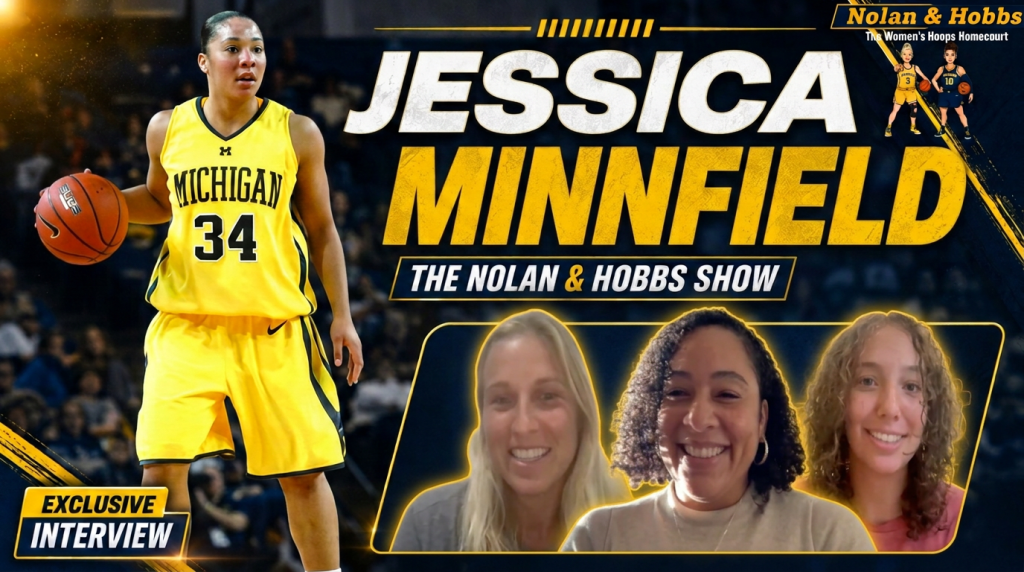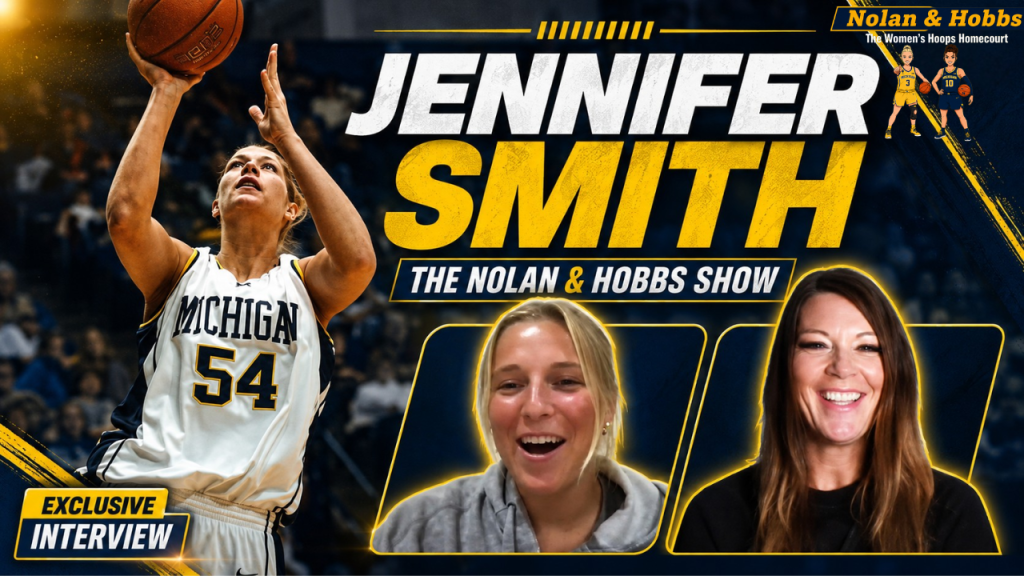
Shimmy Gray Michigan basketball alum, former coach and sports broadcaster, joins Maddie Nolan and Jordan Hobbs to share what it’s like to break barriers in sports broadcasting. In this episode, Shimmy Gray Miller shares her journey from the sidelines to the spotlight, revealing the challenges and triumphs that come with being a female broadcaster in a male-dominated industry.
You’ll discover how Shimmy turned her passion for sports into a career that has influenced countless aspiring broadcasters. She dives deep into her experiences with Big Ten and WNBA broadcasts, offering insights that go beyond the microphone. Expect to learn about the art of storytelling in sports, the importance of authenticity on air, and what it truly means to elevate women’s sports coverage.
Maddie and Jordan explore Shimmy’s unique approach to interviews and how she navigates the pressure of asking the right questions. With her candid perspective, Shimmy provides listeners with actionable tips on enhancing their broadcasting skills, making this episode a must-listen for anyone interested in sports media.
Why does it matter? As the sports landscape evolves, the need for diverse voices and perspectives becomes increasingly crucial. Shimmy’s insights not only highlight the importance of representation but also inspire listeners to pursue their own passions fearlessly.
Don’t miss this engaging conversation filled with laughter, wisdom, and an inside look at the world of sports broadcasting. Perfect for sports enthusiasts, aspiring broadcasters, and anyone looking to be inspired by a trailblazer in the industry. Tune in and get ready to elevate your game!
Find more episodes along with other shows on Hail Media here on the website, and subscribe to our YouTube channel! Find us on all the socials at @HailMediaGroup!
Hail 〽️edia.
Our Stories.
Our University.
Our Team.
Go Blue!
<details>
Shimmy Miller Michigan Basketball | Nolan and Hobbs Ep. 40
Click to Read Full Episode Transcripts
[From Crisler Arena to courts around the world, they wore the Maize and Blue. And now they’re bringing you the game inside and out. Hail Media presents Nolan & Hobbs, the women’s hoops homecourt podcast, hosted by Maddie Nolan and Jordan Hobbs.
Hello everyone and welcome back to the Nolan & Hobbs Show with me, Maddie Nolan, and my co-host Jordan Hobbs. We have a really special guest today. Someone that you guys probably have heard of or heard her voice before on Big Ten broadcasts or even WNBA broadcasts. None other than Shimmy Gray Miller.
Hello everyone. We are so excited for our guest today. Shimmy Gray Miller. Welcome to the podcast.
Thank you guys. I’m more excited than you are. I think this is awesome. I don’t know.
In the back of my mind, I’ve had the idea that I wanted you on for a while and I’ve just been waiting for a right moment to ask. So, we are very pumped to have you.
Awesome. Awesome.
Well, let’s just give some background info on Shimmy. She’s from Flint, Michigan. Graduated in 1994 with a degree in sociology. Served as team captain from 1993 to 1994. She is a recipient of the Bob Ufer Quarterback Club Award for dedication and leadership, played professionally in Portugal, has 24 years of coaching experience under her belt, and is the current Chicago Sky and Big Ten Network broadcaster. She’s done quite a few games for the Michigan Wolverines, so you guys are probably pretty familiar with her voice, but that is a lot of information and a very successful person in front of us.
So, we’re very excited.
Well, thank you. I appreciate that, Jordan. You did your homework, which I would expect—nothing less from Wolverines. So, thank you.
And Shimmy, I don’t know if you remember this, but when we made the tournament run in the bubble, you actually zoomed in to talk to our team at the time. I think, Jordan, you weren’t there. You’re so young. No. But I just remember that was so impactful for our team and what we were doing at the time. And that was like my first true introduction to you. So, I was just like, it’s a core memory for me.
Maddie, I remember that. And I even remember what I said to you guys. I told you guys that you were doing what me and my teammates, what we came to Michigan to do. And, you know, for whatever reasons, we weren’t able to. And so, we were living like vicariously through you guys during that run. And we still continue to. So, yeah, I remember that.
It was just so fun. But anyway, we’ll rewind into your life.
EARLY LIFE AND RECRUITMENT
And so your brother taught you basketball with a wire coat hanger hanging over a door, with rolled-up socks. How did you know, like when did you know basketball was truly going to be your passion?
You guys seriously did your homework. Yes. My big brother Rob, that’s how we started playing and I just loved it. I think really what it was is that was something that me and my brother had. That’s where my love for basketball grew, because I love my brother so much. He would play basketball with me, and we had that connection. In a way, basketball keeps me connected to my brother, who’s since passed away. That’s where it began.
My love of the game came from my love of my brother. Oh, that’s really special.
I mean, going into college, you obviously went to Michigan, but you’ve mentioned that you almost went to MSU. Can you talk a little bit about that switch?
Yeah, man. You guys are just continuing to impress me. Who has the investigative reporting degree between the two of you?
Both of us, but it’s Jordan.
Yeah, man. Yes. I thought Michigan State. I thought I was going to be a Spartan. You know, I’m from Flint, right? You guys said that. And so Michigan State—everyone in Flint loves Sparty. And you think about the Flintstones and all the guys from Flint who, you know, are Spartans. They showed the most interest in me. They would come to my games a lot. Actually, Sue Guevara was an assistant at Michigan State. She was my lead recruiter.
She ended up being the head coach at Michigan, but she was my lead recruiter. She was great. And I remember she came to a game we played like Owosso or someone like that, and I hit a game-winning shot and she wrote me a note and she called me like money, right? And I was like, “Oh, money. That’s my new nickname.” And no one was calling me that. Like, no, that was not going to be my nickname. But they got a commitment from someone from the Detroit area who was, you know, I guess they thought she was better than me.
And so, she committed and then they just dropped me. And, then I just assumed that, you know, Central Michigan was really good at the time. Toledo was actually really good at the time. I had a lot of out-of-state offers and so, you know, I just didn’t think I was going to be going to school in the state of Michigan. And I had a really good summer and I got a phone call the first day that you were allowed to call recruits.
Michigan called me. Took me down to a football game. It was a Notre Dame football game. It’s over after that. Yeah. Yeah. I ended up taking three official visits, but it was not the same.
The Big House will get everyone on there, especially against Notre Dame. Oh my gosh, that is so cool. So, your senior year, you were captain.
LESSONS FROM SENIOR YEAR
You talked about having seven people on your team, five of them being freshmen. What was that like? And then how did it also help you when you became a coach?
Oh my god. What was that like? Did you see that record? That’s what that was like. That was hard. We had a coaching change and we had a lot of turnover. So she kicked a lot of players off that weren’t meeting her standards and then a lot of players just quit on their own because she was hard. She was really hard. And so I actually redshirted. So I had two freshman classes. I redshirted my true freshman year. So the kids that I came in with as true freshmen, they all quit or got kicked off.
And then my redshirt freshman class, they all quit or got kicked off. I was the only one left. And I literally had these five freshmen. Jennifer Brzezinski was a sophomore and we were getting handled. I mean, the Big Ten was like how it is now. It was so good. Penn State was number one in the nation. You had Iowa was a Final Four team. Ohio State, Purdue, so good. And we were just getting crushed. Yeah.
But I learned a lot and I wouldn’t change it for anything. I think going through that year as hard as it was, that’s where my mindset of focusing on the process, not the outcome, that’s where it really kicked in because if we just focused on the outcome, then that year was a total failure, right? But it wasn’t. You know, I grew so much as a leader, I know for a fact that I helped those young players grow and persevere. It was my mission to make sure none of those guys quit, and they didn’t.
One would end up being team captain herself. To this day, we get together, they still call me captain. It was all about the process of just sticking together, being resilient, just really kind of being true to like Michigan, right? Like that’s what the University of Michigan is about. And “Hail to the Victors” and “Those who stay will be champions.” And I didn’t win a championship on the court, but I won a championship like in life because of that year. I wouldn’t change it for the world.
Oh my gosh.
Maybe a few more wins. Maybe a few more wins.
SPONSOR BREAK
Hey Michigan fans, we will be right back. But first, a word from our sponsor. For generations, Knight’s Steakhouse has been an Ann Arbor tradition. Family-owned and serving the community since 1952. From hand-cut steaks and fresh seafood to classic cocktails and genuine hospitality. Visit Knight’s on Dexter Avenue or downtown Ann Arbor. Knight’s Steakhouse. Great food. Strong drinks. Ann Arbor tradition.
Hey fellow Michigan fans, this is your A2 Homegirl Sheri Weintraub with eXp Realty. I am a lifelong Michigan fan. I know Ann Arbor. I know real estate and I know what it means to Go Blue. Find me at a2homegirl.net.
Big shout out to our sponsors, Valiant Apparel, makers of the Hail Media merch, and it is on the website now. So, make sure you guys go and get some. Also want to give a shout out to OLIPOP, a new kind of soda, my favorite kind of soda. And probably Maddie’s as well. Thank you to our sponsors for helping our channel.
COACHING AND LEADERSHIP
That’s fair. I feel like as a senior and everyone kind of experiences, you feel so much older than the younger kids on your team. And for your situation, you had that big gap like five freshmen is almost like you’re another coach. When you moved into that first coaching role, did you kind of see similarities between how you were as a captain and a leader on that team your senior year?
Yeah, for sure. So, as an assistant, you’re very limited with the kind of impact and reach that you have, right? You know, you don’t really make the decisions, you make suggestions, and you know, but the head coach is really in charge, right? And so, what I learned my first few years as an assistant is I remembered what it was like to have bad captains or bad leaders or to have a head coach who because I wasn’t playing much, you know, I didn’t play at all.
Obviously, my redshirt year, I just kind of felt forgotten. And that was my job to make sure as an assistant that I was the captain of the end of the bench, right? The kids who weren’t in the rotation, the kids who weren’t going to play. I remember when I was at University of Washington, we had a kid who tore her ACL, she didn’t get to travel. I remember what that was like. So, I would make sure that we left for road trips on Wednesdays.
Back in the Pac-12, you used to play Thursday and Saturday. So we would leave on the road trip on Wednesday. So Tuesday night I would take her to go get ice cream. You know, every Tuesday night before a road trip and then when I left Washington to move on to another school as a going away gift, she got me an ink pen. It was an ice cream cone-shaped ink pen, right? So I valued that as an assistant, being the captain of the forgotten kids, the ones on the end of the bench because I just think that’s so important.
You can’t just coach the top seven or eight kids.
100%. And that’s where the true impact of coaching is really seen. Obviously, you see it in something as small as an ice cream pen, right? That’s like where you just carry it forever. That’s so cool.
So, obviously you coached for a really long time. And was there anything when you started broadcasting that you had to unlearn from your coaching days?
TRANSITION TO BROADCASTING
Yeah. That first year was rough. The first year was rough because as coaches we tend to be hypercritical, right? I mean, you guys can win by 30 and Coach KBA (Kim Barnes Arico) is still going to talk about the turnover that you had back in the first quarter, right? And so what I learned is that in broadcasting like people don’t want to hear that, you know, she missed the layup. They want to hear how good the defense was. So, I had to work.
I had to unlearn a lot of those bad habits. I had to remember who was in my locker room. In my locker room as a coach, it’s players. It’s other coaches. I can be critical. I can point out, you know, still some positive stuff, but we got to teach, right? We’re always teaching. But in my locker room, when I’m on television, when I’m broadcasting, my locker room are parents and grandparents, you know, and little kids and recruits. And so I’ve had to find a way to still have my teaching moments, but that I’m really focusing less on criticizing.
It’s not my job to criticize. That’s their coach’s job to criticize you. I don’t want to be like another coach on air. So I had to unlearn a lot of that negativity and criticism that coaches often carry with them.
Definitely. Yeah, that would be so interesting.
I got in trouble. I got in trouble—not by my bosses. But I ended up deleting my Twitter. It just got so bad. You know, because heaven forbid I say that, you know, Caitlin Clark turned the ball over too much and that’s all that people hear. And so it’s like people just lock in like, “Oh, she hates Caitlin.” I don’t hate Caitlin. I think she’s the best college women’s basketball player in the game. And that’s for like another podcast.
People can argue me with that. I don’t hate her. I just thought she turned the ball over too much. So I had to really unlearn that. I had to learn how to say things better or how to frame things better.
Yeah. I was thinking as a former player as well, I was like, “Oh, what if I went into broadcasting?” I was like, “I would have to do one where it could be uncensored because I’d be like, “What the [expletive] is happening here?” Like, duh. And I don’t know, maybe when you watched Michigan, too, are you almost more critical because that’s your school or do you try and go the opposite way?
No, you’re absolutely right, Maddie. You are absolutely right. Again, I got in trouble for that. Not from my bosses, but from Michigan fans. And some people on Twitter were like, “God, you think she went to Michigan State?” You know, but I wasn’t trying to do it, but I just didn’t want anyone to think that I was being biased, right? And it didn’t help that my first Michigan game was against Michigan State. Come on. I kind of felt like they threw me under the bus on that one.
But then also just learning to stop saying we. I said that a couple times.
Yeah. I feel like going to the Big Ten experience two summers ago, I was learning so much about what you can and can’t say and like things you have to think about. I mean, also being live is so tricky and having someone in your ear and there’s so many things people don’t realize about broadcasting how hard it is.
Did you like it?
I loved it. Yes. Yeah.
So, when you’re all done playing, right?
GROWTH OF WOMEN’S BASKETBALL
Oh, yes. That is a possibility. But you’ve really had a front row seat to the growth of women’s basketball through playing, coaching, and now broadcasting. What has that been like for you and what does it mean for you to see that?
It’s been phenomenal, you guys. I remember when I was in middle school, high school, they only showed three women’s basketball games on television a year. It was the two semifinal games and the national championship game, and that was it. And then they didn’t have the WNBA when I graduated. The WNBA came along a couple years after I graduated. So to see even that, I remember when Detroit Shock won the WNBA championship, they had to play it at Eastern Michigan. I watched the Golden State–Atlanta game last night. To see all those people, sold out, and to see how they’re making an effort to get the game back in Atlanta at State Farm Arena. At our games at Michigan, no one would come to our games.
No one. I remember giving homeless people tickets so that they would come to our games. And now I go to a Michigan game now and you guys are like, I mean, thousands and thousands of people. It’s phenomenal.
I got chills thinking about the Valkyries, just how they’ve been able to sell out their stadium consistently in their second year as an expansion team. It makes me so excited for Detroit to come back. Obviously, Cleveland’s going to be really fun. Philly. It’s just a really exciting time in women’s basketball right now. Yeah. And I’m happy that you guys are getting what we didn’t get. Like I’m not one of those old old players who were like, “It’s not fair, you know, like now they get all the attention and the good stuff.” No, I’m happy that this generation gets to experience what we did not.
And I do think it’s phenomenal. It’s like what they say, everyone is watching women’s sports.
It is. And well, your generation and those before you were the people who built the foundation. You guys were obviously a huge part and a huge impact of that because without you continuing the fight, we wouldn’t be able to have these games on TV or have all these fans, right? So, it’s really a collective thing from whatever the 70s or even before then when they weren’t even recognized as a sport. So I think that’s the really cool part that we can try and come together and be like we all were able to build something like this.
For sure. For sure.
QUALITIES OF ELITE PLAYERS
So as a former coach and obviously you spend a lot of time around the game of basketball. What are some qualities that you think set players apart that help them reach the collegiate level and then the W?
For sure it’s the work ethic, right? Like let’s just assume that everyone has the same talent, right? And so then as a recruiter, I’m always looking at separating factors. So who’s putting in the unrequired work? Like if you’re doing like just the bare minimum or if you show up to practice and you do what’s required of you, that’s great. Like that’s good enough to keep you on the team. But it’s the players who are putting in the unrequired work that start to separate themselves.
And then after that, you’ve got to look at the mental piece of it—the resiliency that we talked about a little bit earlier. Who’s going to quit when things get hard? I know that KBA is tough on you guys. Who are the ones that are just like, “Hey, I didn’t sign up to get yelled at,” or, “This is too much for me”? Because if you can make it four years of playing for someone who’s demanding and playing at the highest level, you have no idea how far that’s going to carry you in life.
There’s no boss that I’ve ever worked for that I wasn’t prepared for because of my experiences at Michigan. There are no challenges that I’ve ever had—and I’m talking real-life challenges, like my mom passing away, my brother passing away. Everything that I’ve learned, all my coping skills, my resiliency—all that I learned through playing college basketball. So if you can make it, you know, at that level, then you can do anything in life.
And so the unrequired work piece and then the mental aspect are the separating factors for me.
That’s very cool. We also want to pick your brain on some Big Ten topics since we have the expert in front of us. So we need to ask some questions about it.
BIG TEN BASKETBALL INSIGHTS
Who is your sleeper pick in the Big Ten both for teams and players?
So, my sleeper pick was Minnesota, but now the news just broke about Tori McKinney tearing her ACL. So, I think that’s I think she was their best all-around player, and that’s a tremendous blow. I’m going to go my sleeper pick is Illinois. I just think they’re so talented, and them bringing back 11 players. Again, Shauna Green is another coach who’s really demanding and they play so hard, very similar to Michigan. They defend at a high rate. They can score. I like the pick-and-roll that they do.
It’s hard to guard. And then my sleeper player is Berry Wallace. I’ll stick with the same team. Everyone’s talking about Olivia and Jaloni and JuJu. And for all good reasons. But Berry Wallace is sneaky. Like really, really good.
It is crazy when you think about how little she is talked about cuz she averaged over 18 points last year and is just so consistent. And you’re right, no one ever talks about her for any accolades or anything like that. So that’s a good sleeper. I like that one.
Yeah. And she plays like four positions. Yeah. True.
I think it speaks though to the level that the Big Ten is at where you have a player of that caliber, but because you have a UCLA team with six WNBA draft picks, you have a USC with a Jazzy Davidson last year, right? You have Ohio State, you have Michigan, you have all these teams that are Sweet 16, Elite Eight, Final Four, national champions that she just doesn’t get mentioned as much because her team wasn’t at that level, right? So maybe this year is a good opportunity for them to break through and then for her to get that recognition that she deserves as well.
Yeah, Illinois will go as far as she goes. So for sure.
Love it. So we talked a little bit about JuJu. What are your thoughts on USC this year? They’re going to be loaded. How do you think that’s going to kind of work out?
I think they’ll be fine. And I’ve kind of talked about this before on other podcasts. You know, well, there’s only one ball, right? You got all these superstars and one ball. But just go down history, there’s always only been one ball. Maybe before your time when Tennessee was really, really good, when Pat Summitt was a head coach, and they literally had, I think, three or four All-Americans on that roster. You know, they had Chamique Holdsclaw, they had Semeka Randall, they had Tamika Catchings, and then Connecticut back when, again, maybe before your time, but they had Swin Cash, they had, you know, Tamika Williams-Jeter, who’s the head coach now at Dayton.
They had Sue. So they had like literally I think they had the top four WNBA draft picks. You can correct me. You can fact check me on that, but I think they had like one through four WNBA draft picks, right? And they still found a way to make it work. So I think USC will be just fine. That’s a nice problem to have is to have too much talent. I wouldn’t mind that. I think Lindsay Gottlieb is a phenomenal coach. She runs a pro-style offense.
And I think USC for me, they are my frontrunners to win a national championship. And they will never get the credit they deserve on the national level because ESPN rules the roost, right? And so I think ESPN will always go with like an SEC team or Connecticut. And I just think that USC is really really good and they’re really well coached and they defend and they defend.
Yeah, that’s a good point. And from the videos I’ve seen, it looks like JuJu hasn’t even like missed a beat. Like her body looks so good and athletic and it doesn’t even seem like she had an injury. So I’m excited to see her back in full action in a game setting. I mean, you have the I mean, she was a national player of the year when she got hurt, the year she got hurt, right? Yeah.
And then you look at everything that Jazzy Davidson did this past year. Then you bring back Kennedy Smith if she can shoot the ball better than she has. Watch out. And then that number one recruiting class. And then they picked up a really a couple of really good transfers, too. So, they’ll be I think they’ll be really good.
Do you think there’s any underrated coaches in the league? And why?
Oh my gosh, that’s a tough one, J.
BIG TEN COACHING EXCELLENCE
Obviously, I’m a Big Ten girl, right? Played in the Big Ten, coached in the Big Ten. Now I work for the Big Ten. So yeah, I’m biased, but it’s not an uneducated bias. Like I can support everything I say, whether you agree with me or not, I can support it. And you can’t argue when someone brings their facts, their receipts, right? I think what separates the Big Ten from other conferences, and I’ve been an assistant in the ACC, the Pac-12, and the Big 12, the A-10, all of them.
I’ve been an assistant in all four power conferences, plus the A-10. And what separates the Big Ten is the coaches. Everyone has talent. Everyone has a great fan base. Not everyone has great universities, but you know, but it’s the coaches. I did the math. I crunched it last year. So, this was last year’s coaches. Now, they’ve added Carla Berube and Gary Redus and Tanisha Wright. So, but last year, every single coach except for one had won either a national coach of the year or a conference coach of the year or a national championship at some level, whether it was Division III like Robin Fralick or Division I like Brenda Frese and or a conference championship.
Every single one, the only one that hadn’t was Jan Jensen. And she was only in her second year and she did win like national rookie coach of the year, right? But other than Jan Jensen, every single coach and I’m talking about even like Coquese Washington who did really poorly at Rutgers, but she still won three Big Ten championships when she was at Penn State, right? She was still coach of the year twice when she was at Penn State.
So like you name another conference where 17 of the 18 coaches have won, you know, have at least one of those accolades and I couldn’t. I tried to do the math and I couldn’t. And so I think like that’s a really tough question for me because I think all the coaches in the Big Ten are like incredibly smart, incredibly innovative, their game plans, their scouting reports. I will be curious to see how the three new coaches do. I think Carla Berube has an advantage her having been a successful head coach at the collegiate level.
Gary Redus, I think his route will be a little more challenging because he’s never had that clipboard. He’s never commanded a timeout. But this conference separates itself from other conferences because of the caliber of coaching.
I love that. I just remember when we were playing, too, every night you have to be ready, not only physically, obviously, but mentally. The schemes change, and everyone’s so good at in-game adjustments. I think that’s something that fans don’t always get to truly understand or hear. So I really appreciate you like pointing that out.
So good. So smart. They’re so smart.
RAPID FIRE AND CLOSING
Okay, so we’re going to go into some rapid-fire questions about your thoughts and opinions on the upcoming women’s college basketball season.
Who is your best player in the country when the game is on the line?
JuJu.
Perfect. A player in the Big Ten whose stats don’t tell the whole story?
Elsa Lemmilä. Yeah, her.
Perfect. One basketball trend you wish would disappear?
Oh goodness. Flopping. I hate it. Maddie, were you a flopper?
Maybe once.
I just hate it. And I just think you look silly. What happened to this call? Referees got away from this; they never called it. I just think it’s so soft. I hate it.
Yeah, that’s a good one. Would you rather have an elite point guard or an elite post on your team?
Point guard. Post players are only as good as the guards around them.
Good point. One rule you’d change in women’s college basketball?
I think that coaches should be able to review fouls just like we do in the WNBA.
One thing you miss most about coaching?
Practice.
One thing you do not miss about coaching?
Recruiting.
Oh, good one. Favorite place that you have called a game?
Iowa. Carver-Hawkeye Arena. It’s incredible.
Gosh, that hurts my heart, but I understand. I understand.
Oh my gosh. Well, thank you so much for coming on today and letting us pick your brain and learn more about your experience as a coach, as a broadcaster, as your time at Michigan. This was so much fun, and we’re going to be so excited to watch you and listen to you this upcoming season and support Michigan with you. You’re the best. Thank you, Shimmy.
Thank you guys so much for tuning in today. And a big shout out to Shimmy Gray Miller for hopping on. We absolutely loved getting to pick her brain and learn more about her and be able to share that with you guys. And as always, Go Blue.
If you like this kind of content, please like, share, follow, and subscribe. And as always, go blue!]