Matt Aldred Michigan Basketball strength and conditioning coach joins Tim McCormick on Go Blue Hoops to discuss the training, player development and team culture that help prepare the Wolverines to compete at the highest level. Aldred shares his approach to individualized training, mentorship and accountability, while offering insight into Dusty May’s vision for the program, emerging talent and the work that helps players grow on and off the court.
Topics Covered: • How Michigan develops players behind the scenes • Strength and conditioning strategies at the college level • Dusty May’s vision for Michigan Basketball • Building leadership, accountability, and team culture • The Player Mentorship Model • Innovative Coaching Strategies • Recruiting and identifying future stars • Preparing athletes for long-term success • The future of Michigan Wolverines Basketball
Find more episodes along with other shows on Hail Media here on the website, and subscribe to our YouTube channel! Find us on all the socials at @HailMediaGroup!
Hail 〽️edia.
Our Stories.
Our University.
Our Team.
Go Blue!
Matt Aldred Michigan Basketball | Go Blue Hoops Ep. 36
Click to Read Full Episode Transcripts
[Hail Media Group presents Go Blue Hoops, where Michigan basketball’s past, present, and future all come together in one show. Hosted by former Wolverine great, 10-year NBA veteran, and longtime ESPN and NBC college basketball analyst Tim McCormick. Each episode goes beyond the box scores from championship memories and recruiting stories to sharp breakdowns of the season ahead. Insight, legacy, Michigan basketball. This is Go Blue Hoops. Hey everybody, the Go Blue Hoops podcast is presented by the leaders and best at Michigan Medicine. There’s a difference between an answer and a Michigan answer. To find your Michigan answer, visit michiganers.org.
Welcome to podcast number 36. And this has been a lot of fun just having the freedom to talk about whatever storylines are going on in the off season for Michigan basketball. June and July are really the two best months for guys to separate from the competition to be able to add strength to sharpen skills and add to their game. The Michigan players have to be in town by Saturday of this week and they’re going to go to work to make sure that they can try to repeat a trip to the Final Four. The players have been home all over the country searching for different workouts.
These guys will travel to California because they get a chance to work with a pro or an NBA guy. There’s so many opportunities. Trey McKenney was down working with Ricky Lifford in Florida and then all of a sudden Trey McKenney is in California. Then he’s at the MIS Speedway and then he’s throwing out the first pitch of a Tigers game. I talked to Oscar Goodman this weekend. He’s in California coming back to Ann Arbor getting some great workouts. Guys are all over the place. Aday Mara is on tour visiting NBA teams. They’re interviewing him. They’re watching him shoot the ball, trying to establish his draft status, which is absolutely soared.
Looks like Aday Mara is going to be a top 10 pick in the NBA draft. And then most importantly, if you want to play this fall, now is the time to impress your coaches, learn the offense, get strong and fast, and work on your nutrition. So many great things that these players can do. So I’m really excited to welcome you to episode number 36 of the podcast. I am so confident you will enjoy the content. We’re really fired up about our guest today. His name is Matt Aldred. He’s the strength and conditioning coach for Michigan basketball.
And in our Michigan man interview, stay tuned. He will blow you away. We’ve had 36 different interviews. Matt Aldred may be the best that we’ve had. And I remember we had Charles Barkley. So the fact that I’m comparing this in terms of quality should tell you a lot. All right. Since there’s no games to break down, I thought there were a couple of basketball commentary opportunities for me. You may have seen at the Mackinac Policy Conference at the end of May, Dusty May hinted that Michigan basketball would eventually hang a Fab Five banner sooner than later was his words. He praised the impact of the Fab Five on the entire culture of college basketball.
He compared the Fab Five to Michael Jordan. Unbelievable praise and I really appreciated his comments at the UCLA Michigan game. Earlier, I think it was in February, Michigan had a basketball reunion and the overwhelming sentiment from former players was that th this has gone on too long and that the banner should be raised. It’s just as important that the records of the five teams that were eliminated, there are many innocent players that have gone unrecognized because of what’s at stake. What is at stake? The 92 and 93 Final Four banners, the 97 NIT Championship, which Robert “Tractor” Traylor was MVP, the 98 Big Ten tournament banner, should be up in the rafters, and the bans have all expired.
The university allowed Jalen Rose to give their commencement speech, a stirring, motivational commencement. And it’s great. And it’s time to forgive and forget and move on. And I certainly thank Dusty May for being proactive. Right now, I’m sure it’s in the hands of athletic director Warde Manuel, the president, and the regents. So, what else? As I said, there’s no games. There’s no upcoming matchup to preview. There’s no game to break down. So, I’ve got the freedom to talk about whatever I want to. And today I want to start talking about our freshmen. We don’t really know them yet.
Next week I’m going to go to practice. I’m going to watch and start to learn about them and I’ll share those thoughts with you. But today thought it was a great opportunity to start off with Quinn Costello. Stay tuned. This kid is going to be really good. I saw him play at the top 100 camp when he was in high school. That’s a long time ago. I’ve watched his videos. There’s a lot to love and I believe he’s a future star for the Michigan Wolverines. McDonald’s All-American. The first thing that jumps out at you is he’s just a beautiful shooter.
High release, quick trigger, and if I’m looking for a comparison, he reminds me a little bit of Dirk Nowitzki when he came to the United States. Dirk was a little bit older at that point. And I hate to compare a kid transitioning from high school to college to one of the greatest players of all time, but just his body and the way he moves and especially the way he shoots. As I said, beautiful shooter with deep range. Quinn Costello is the prototype face up four on offense. He will play immediately because of his ability to spread the court. If you put Quinn and Trey McKenney on the court together, there is so much space for the teammates to be able to get to the rim. On defense, it’s going to take some time and create some challenges.
Whereas Morez Johnson and Yaxel Lendeborg could cover one through five with ease. I don’t think that’s realistic right now. Quinn Costello is going to play defensively the three and the four and there will be some guys that are tough for him to match up. I don’t see him being able to cover a Big Ten center at this point. The size and the strength will come for sure. He’s 6’10”, 195 pounds. Coming out of high school, I was 6’10”, 195 pounds as a senior in high school. Quinn and two years later I was 6’11”, 235 pounds. So I project that kind of size once Matt Aldred gets Quinn Costello in the weight room on a consistent basis. The other thing that I like so much about him is that he is going to stick around for a while.
I believe that he’s going to love the Michigan culture. So every year you’re not going to worry about him leaving. Number two, why he’s so appealing to me is that he can be here for three, four, or five years and really become one of the best face up shooters on the front line that Michigan’s had. A couple of other comparisons. I think that he’s a more advanced version of Will Tschetter when he showed up. And you saw how Will really embraced the ability to cover on the perimeter. I think that eventually Quinn will be able to do that.
He’s a much more talented Will Tschetter. Also, when I look at the benefits for Quinn Costello, he’s going to get mentored and tutored by the veteran players, Chum and Estrella and the guards. They’re going to take him under their wing and teach them the ropes of how to be a professional. I remember as a freshman, I wasn’t really ready to play in the Big Ten. But Paul Heuerman, who was a senior, did a great job of mentoring and role modeling with me. And then eventually I was able to step into the starting lineup after Paul left and a guy named Roy Tarpley came to Michigan and I mentored and tutored him and showed him what he needed and so that’s really important.
And if players feel like they’re appreciated and they’re growing and they’re getting a chance to develop their skills, they’re going to stay around as long as they can to get more and more. So, I think that Quinn Costello will back up JP Estrella and will really benefit from watching and learning and he’s going to get a chance to contribute. And last on my basketball commentary, I think Dusty May is a great innovator. He’s an idea man for sure. And he hired Mody Maor from Europe. He is brilliant at roster construction. His scheduling is incredible. Well, the other thing that he did this week, I love the move to take Duke versus Michigan from New York City into the Miami Marlins ballpark.
Yes, Michigan is going to play a basketball game in a baseball stadium. It kind of reminds me when Michigan State played against North Carolina on an aircraft carrier. Everybody that likes college basketball was watching. Duke, Michigan, like that’s not enough. Everybody is going to be watching this game. I think it’s brilliant on Dusty May’s part. And it keeps telling me as we are going to have NBA teams constantly reaching out to Dusty, checking to see if maybe he wants to coach in the NBA, the fact that Dusty May is being so innovative and coming up with new ideas and constantly searching how to upgrade his roster.
Dusty May is going to be in Ann Arbor hopefully for a long, long time. Hey Michigan fans, we will be right back. But first, a word from our sponsor. When prenatal surgery is your baby’s best chance. When your sight is set on gene therapy for retinal disease. When a new airway is what you need to keep breathing. Only Michigan answers with specialized treatment options that aren’t available anywhere else in Michigan. We provide the nationally recognized care you need without having to travel out of state. Learn how University of Michigan Health answers the call at michiganers.org.
All right, it’s time for our Michigan man interview and we’ve got a treat for you. Matt Aldred is the third-year strength and conditioning coach for the Michigan basketball team and trust me, he played a massively important role in the national championship. Michigan stayed healthy for the most part. Very strong at the end of games. They were dominant last 10 minutes of close games. Matt, congratulations. Thank you for joining us and a fantastic job. Thank you. Yeah, thanks for having me on and excited to dive into a lot of you know those the big questions and all that.
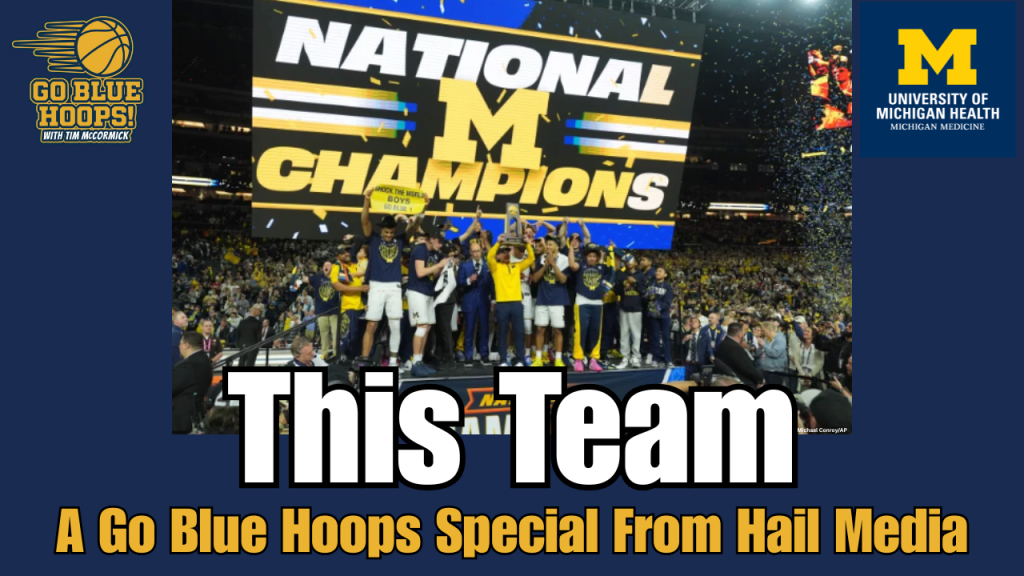
Yeah, we’re going to have fun with it and I’d like to start off with just your experience with the national championship. What was it like for you? What do you remember when it actually happened? It must have been surreal. Yeah, it’s very surreal. It’s always interesting, you know, at what point in your head do you go, we’ve won this game. You know, there’s so many moments of like, you know, Trey’s big shot was like that was a big relief, but even before Rody threw the ball down the court, you’re always like, have we won it yet?
Like, is it done? Is it done? And so, I think that moment is like it’s highly stressful first off because when you’re sitting on the bench at the end of the bench, you got zero control. So, it’s something I’ve had to regulate as my stress during these games. But yeah, I mean once it happened it was just like wow like this is this is it you know this is the pinnacle of the sport. This is yeah my first reaction is just joy for the boys you know they just work so hard and to see them all celebrating on the court and the adversity they’ve been through. Yeah just I mean just supremely special surreal still hasn’t quite sunk in that we actually completed it and so yeah just it’s the gift that keeps giving.
There’s so much joy that’s come from it and memories and you see memorabilia we get given and yeah, it’s just I think this team it’s going to be hard to top. We’ll definitely try but just I think we’ll really appreciate this team for decades to come as players, individuals, staff, everything. So it’s the gift that keeps giving. Matt, when was the first time that you said to yourself, “Man, these guys are good. We could win it all.” But was there a point last summer in the fall? Was there a game? When did you first think we’ve got the talent to win this?
Yeah, I think our exhibition against St. John’s was fun. That was probably the first time that I saw Morez and Aday play for us and I just think they’re like composure in that environment on the road, even though the game didn’t count for much, right? Didn’t count for anything and didn’t count for the 40 games we played in the season. But that’s always the first time when you’re in the heat of battle and competition on the road, that’s like, okay, this team’s got some toughness. It’s got skill. I think Elliot hit a nice three right before the half. You know, but to go into, you know, a hostile environment and win early in the season, even before the season was really a cool moment.
And yeah, I think from there it’s like, okay, like let’s this is this is going to be good. You work the guys really hard in the weight room conditioning-wise during the NCAA tournament during the final four. What is a weightlifting program like for the players? I would imagine they’re not trying to really gain, they want to maintain, but how often are they lifting? What does it look like during the NCAA tournament? Yeah, great question. So obviously we get there probably two days, two or three days earlier than probably normal. Normally would get the night before game. And the key thing is to kind of keep the schedule as similar as possible.
The last thing you want to do is give these guys a spike in workload, especially from me in the weight room. So you want to keep it as structured and as simple and as routine as they’ve done for the last 5 and a half months of the season. So, the only thing we don’t have is obviously our weight room when we’re on the road. So, we use the hotel weight room. And I’ll go in there and I’ll see kind of what equipment they have and we’ll do very similar movements. It’ll be a lot lighter weight because they only go up to 55 lbs in that in the hotel weight room. But for me that’s that’s not a big deal at all.
I’d rather go on the on the lighter to moderate side, especially so close to a game. These guys are going to be very highly strung, very motivated, arousal, adrenaline, all that. So, the last thing you want to do is kind of overdo it in the weight room the days before. But, you do need to get rid of some of that energy and keep training the muscles and movements so they stay healthy. So we would do a lift, you know, in the hotel two days before a game. The day before a game and then I think I had them in there on the Sunday as well, doing a recovery lift.
Again, that’s very similar to what we would do throughout whole of March. We would use that space and have whatever music on they want, do some soft tissue work to make them feel good. Chris, our athletic trainer, does a great job with getting these guys massages organized as well. So, that’s something to keep them ready. But really, it’s it’s the minimum effective dose is something that strength coaches might talk about in season. We are not the focus. The late weightlifting session is not the focus of that week at all. But we do it to keep them strong, to keep them confident, to keep their routine, and have fun with it as well.
The science of building strength is fascinating to me. You talked about a recovery lift. What’s that? And when you when you consider your entire team, does everybody have an individual workout program that they do? For instance, does Elliot Cadeau lift the same program as Morez Johnson? Great question. So, the first one, recovery lift would be a lot of it is going to be full body multi- joint movements. So, think of like holding a kettlebell at your chest and doing a full range of motion squat. Holding a Viper, which is a cylinder that’s kind of like a PVC pipe, and going in different ranges of motion.
It’s really just to stimulate blood flow. There could be some direct arm work, so bicep curl, tricep press down. There could be some hamstring work, but definitely some soft tissue stuff, so they’re foam rolling. Really, you’re just trying to stimulate blood flow, but also give the body a strength stimulus so it knows that in season we can’t just turn into marathon runners and get super skinny. You’ve got to maintain that muscle mass. So, it gives the muscle enough stimulus to be like, “Okay, we’re still here. Good. We’re maintaining our muscle mass.” And also, you’re still training strength through ranges of motion.
So, that should give some protective element for the game. And then the individualized question is absolutely correct. Yeah, Elliot does train very different to Morez and Aday. It’s actually the fun part of my job right now is creating these individualized plans for these guys in the summer. So we have eight weeks of training. That’s really the eight weeks of really individualized work where I can look at what Elliot wants to do, what he thinks he needs to improve on, what coach thinks he needs to improve on, what Elliot’s people, if they have a say in it, what they think he needs to work on, and then obviously my eyes on it as well.
All four of us kind of can get in the mix there on what he needs to improve on and then he has the eight-week period to really dial in on what he needs. Same would have been for Aday for Morez. You speak to all these players and they have a real good sense of what they need and sometimes it’s a body weight goal, sometimes it’s a lateral movement, quickness, obviously we switch one through four. So that’s really important for our bigs to be able to move well. And then it goes to preseason. So we normally do kind of more team lifts there where it’s conditioning emphasis and then in season it’s very much high minute, low minute guys. And they can have preferences on, say, we do a lot of deadlifts from the floor. Some players might prefer to use a machine instead.
We have multiple machines in this weight room. That’s fine by me as long as we’re getting a heavy lower body stimulus. I let the players kind of say, “Hey, can I do this instead?” Absolutely. Let’s just make sure the weight is super heavy and low reps. That’s basically the protocol in season. But yeah, these guys need a lot of different things. And I absolutely love the individualization process. I think it gets my creative juices flowing. I love input from the players as well. I think that’s really key. You’re like a mad scientist just trying to figure out what’s best for everybody.
I know you’re excited at this weekend. The team has to report to Ann Arbor for summer workouts. Guys like Quinn Costello and Brandon McCoy. So excited to see both of them and the other guys, too. How well do you know their game and how do you determine what kind of a program they’ll be on? Yeah, great question. So for someone like I’ll start with Quinn. We’ve been able to send him some workouts to do. So for the last I think the last month he’s been doing kind of the general stuff we would recommend freshman to do.
Super dialed in, very responsive, sending me the workouts back to what he’s done. He has been elite in his preparation with that. So that’s exciting to see, you know, someone that’s so talented already on some kind of more structured lifting that we want him to do. And again, same for Brandon. Like the first few weeks is going to be very much an observation and analysis from me. There’s certain buckets in my head I think freshmen need to attack. So certain exercise progressions to be able to prepare you for the bigger lifts. You don’t just go straight into a back squat or an RDL or bench press.
You’ll do exercise progressions. So for the most part I have I have the freshman programs printed already. It’s all pretty basic stuff for the first two weeks. And then often times I can imagine those guys being like can I do this stuff now? Can I can I go train with this guy? Can I be with Elliot? You know, and I’m like, sure, we could probably do that. Absolutely. I want I want energy in the room. So, I don’t want to hold you back. But a lot of that training is kind of testing through training. So, seeing them do exercises and going, “How did their ankles go?
How’s his back thoracic mobility? How are his groins? How are his knees?” So, a lot of it is me watching them train, and then getting a good pulse on, hey, he really needs to do this in his next phase. Let me write that down. He could he could do this. And so yeah, that’s the mad scientist piece again for sure. Every team has a couple of beasts in the weight room. The guys just give me more. I, you know, so motivated yelling on bench presses and squats. And who are the beasts on this team? The guys that just really made the biggest gains. Yeah, I would say collectively we had a really good group that was in here that gave great energy.
I really give a lot of kudos to Yaks last year. I think his energy in the weight room was elite. Constantly challenging guys to lift heavier, constantly pushing them. You know, talking crap, but that’s awesome in this space. I love that. Like I felt like he was an assistant coach for me at some times in here, which was a really nice surprise. So he was really kind of raised the temperature in here. But, you know, a lot of those guys, they Aday and Malik had a great relationship in here, constantly pushing each other. Yaks and Morez, Morez and Yaks, EC, LJ, they all had great kind of banter between them of like if I’m doing this, he’s got to do more. And that just raises the temperature, raises the ceiling in the room and that’s really special.
Really cool. Who’s the biggest trash talker? Probably X. Yeah, probably that. Yeah. Yeah. But yeah, he’s awesome. Awesome. Yeah. So Matt, LJ Kase had a serious injury and he’s got a long way to go with his rehab. I’ve been through that and it’s debilitating mentally. You get sad, you get lonely, like you miss your team, you miss playing. How is his rehab going? Is Chris Williams more in charge of it or is that something that eventually you’ll take over? How does that progression work? Yeah, exactly. As you said. So, he’s with Chris every day right now and I think he’s with PTS in the Michigan system.
So, they’re overseeing all of his early return to play RTP process and then once he’s kind of cleared with some stuff, I’ll get the memo to say, “Hey, you can start doing this with him. You can start working on this with him in the wait room.” So, yeah, Chris is doing a great job with him. Their relationship is awesome. They have great chemistry, great again, great banter in there. So, he’s he’s really working hard to get back to his best. I always like to frame it that he’s going to be better than he was before.
I think it’s almost somewhat negative to just say, “Let’s get you back to where you were.” Like, let’s let’s be more progressive with that mentally. Let’s have the psychology of like, I’m going to be better. You have a lot of time to invest in your body right now. A lot of time to invest in your conditioning, your core strength, and everything. So, yeah, he’s he’s doing great. And again, credit to Chris who does an awesome job with our guys and he’s doing a really good job with LJ right now. So, when I asked who the beasts are in the weight room, I hear that Dusty May works out with the team a lot.
What are his workouts like? Is he pretty intense? He’s always intense. Yeah. You know, coach’s workouts are awesome. They’re very they’re varied a lot. U he likes variability in his training, which I think is good for all due respect for an older guy. I think that’s really important. Likes using cardio pieces of equipment. Sometimes that’s pre-practice just to kind of get him get him juiced up, ready to go. But yeah, he loves training in the same space as the guys. And I think, you know, a lot of our staff do as well, which is really cool.
So, if we have a lift, you know, 11:00, 12:00, and we practice at 2, a lot of the staff will be in there lifting with them. And, and I think I was thinking about this actually prior to this conversation, you know, I think the old adage of what your kids, you know, they learn more from watching you do it than talking about it, right? And I think it’s really cool that our staff have incredible healthy habits and behaviors and they’re in here training and Ake’s constantly like, “Let me get in with Elliot’s workout.” You know, he’ll jump in there and KT is just a beast.
Drew gets in here, Mike gets in here, you know, and then D may will just be doing all sorts of stuff in here. And I think the boys respect it. They love it. It definitely raises the energy in the room. And I love it. I think it’s awesome to have everyone, you know, think about an organization. You want it to be as healthy as you can. So people are mentally sharp. They’re healthy. They’re less stressed. They miss less days. Like from a business point of view, like for our CEO to be training constantly and keeping as healthy as he can, I think is really important.
Is part of your role, the kind of the motivation, the yelling, the screaming, the encouraging you’re capable of more get one, you know, is that a big part of this or at this high level are the players self-motivated and they don’t need that? I think both. I think definitely a part of our role as a strength conditioning coach, like they they come here to play basketball. They don’t come here to lift. They have to lift, right? It’s mandatory and I think they know the importance of it, but they’re going to be more motivated for a skill workout on court for practice than they are for a lift.
So, I think it’s that fine. That’s the art of coaching is having the buying for them to be here and enjoy it, but also if they’re not quite holding the standard or the level that you know they need to and the effort, then that’s where I come in. Have a have a quiet word one-on-one probably first off. And then you know once if that’s if they’re having a tough day, but if they’re having a good day like and they’re lifting some serious weight like, “Yeah, we want to hype it up. Let’s turn the music up, guys.
Hey, Yak is hitting a bench press. Like, he doesn’t think he can do it. Let’s show him he can or he thinks he can do it easily. I think he might struggle. Let’s have a look.” And then they’ll just talk crap and it’ll be fun. You know, I think that’s that’s part of the energy in the room is this isn’t with all due respect like a yoga or palate studio. This is somewhere where it’s like we are going to get after it. This room does value hard work. It values effort. You have to push your body past what it’s done previously for it to improve and to build that resiliency and strength.
So yeah, sometimes it’ll be we’ll be pretty loud and I have a sore throat for a little bit just with all the shouting. You know, our strongman sessions obviously very intense. Preseason’s very intense. I like to have somewhat of a motivating voice at practice. I think it’s important for the warm-ups to get these boys ready to go. If we start practice poorly, I kind of take responsibility for that I didn’t get the guys ready to go mentally and physically. So yeah, there’s there’s some raised voices for sure in that moment. Matt, I remember being in the Michigan football weight room and the football team liked AC/DC and they played it loud.
Does this team have a special playlist or some who do they like lifting to? Yeah, not AC/DC. That’s for sure. U very different vibe in here. You know, our boys were an interesting bunch with music this past year as a few probably viral warm-up videos were shown. It depends on the player. Elliot likes kind of the hard rap. LJ likes NBA Young Boy. A lot of the boys, so let’s say Trey, Rody, and Yaks, they liked Olivia Dean. U, Yaks was obviously a fan of like kind of I would say like girly pop music. Maybe Taylor Swift to warm the boys up a little bit like Miley Cyrus.
We did a lot of that in the warm-ups, but honestly, I really that we’ll keep that between us. No, but I like it. I think it’s, you know, there’s a quote I heard from, it was on a podcast from maybe it was a marine and it was like, you know, be tough when it gets tough. And if we’re warming up for a game, I don’t need you to be stoic, dialed in the weight room, like I want you to be somewhat loose. I want to move. I want to I don’t want you to be completely absent.
Like, I want you to have some focus. But, you know, our boys showed this year and maybe it was just this bunch. Maybe next year be completely different. But they showed that they can have the ability to be very relaxed and very chill. And it’s all energy, right? It’s all just having them feel good. If they if they’re dancing a little bit in the warm up in the corridor before we play an Elite 8 game, I’m good with that. I know they’re going to be ready when the tip comes. And if that’s just their way of kind of releasing some nerves and enjoying time together and kind of chilling each other out, like the music is in part with that.
So when they chose those songs, like their energy in the warm-up improved. And as a strength coach, I think if we’re looking for one thing, we want energy and intent every day. If the intent improves by listening to Party in the USA by Miley Cyrus, like cool, let’s put that thing on repeat. No problem by me. I remember my rookie year heading to a game in Seattle and stopping at the 7-Eleven and grabbing a couple of yogurts and a donut as my pregame meal. Things are a lot different nowadays. What is your role with nutrition and hydration, teaching the players about the benefits of that?
I’m I’m sure you’re involved and have some strong opinions on that. Yeah, I definitely try to be fully aware of what the guys are doing from a nutritional standpoint, from a supplementation standpoint. I think nudging behaviors is something that coaches should really or do value in this space. As strength coach, you have to have obviously oversight of the strength, the conditioning, but also I’m curious about preparation, recovery, sleep, mindset, psychology, relationships. But I would say a lot of the credit for the I’d say all of the credit for our nutrition goes to Hannah, our dietitian.
I think she does a really good job with obviously pregame meals, hotel meals, snacks in the fueling station, post-workout smoothies, postpractice smoothies, supplementation. You know, we work very closely together in terms of I think what players need. So, say a player needs to gain weight, that would be something I will tell Hannah. We look at the DEXA scans the players do and we’ll come up with a plan of what they need postpractice. What supplementation they should be on. And so she does a really nice job with that. And I think we’re both very open to players feedback.
Our player this year wanted chicken sandwich as part of his pregame prep. And he was a very high level player for us. We said, “No problem at all. We’ll get you that every game.” And it worked out pretty good. When you look at the core from this year’s team, Yaks and Aday and Morez and Elliot and Trey, five years from now, who’s going to be the best NBA player? I would think you’ve got some great insight into I’ll steal this from Dusty the special sauce that some guys have. Who’s got that upside with their body and can become a better athlete?
I think they might be two different answers. I think upside with their body. I still think Aday has a real ceiling of growth for improvement with his body and I’m really excited to see whatever amazing NBA team he lands at and how the performance improvements he can keep making. So, I’m really excited to see him. I think for the longevity of an NBA career and who would do the best. I would hate to single a player out. I would I would think they’ll all do exceptionally well. I would definitely be keen to keep an eye on how well MZ does. Just with his attitude and his toughness and his relentlessness on the court. Like I think he will probably be he will probably have a very distinguished career.
Agreed. I want to go back in time. When I played at Michigan, we did not have a weight room anywhere in Chrysler Arena. We would go to the baseball stadium and there was a room there that they had a bench press and that was that was a universal machine. And we did things that were just not productive, heavy bench presses and squats in season. And how is lifting different now when you look at your facilities? And then also when you look at football players and basketball players, how is the weightlifting programs different for each of those groups?
Yeah, I’ll start with the second one. I think football is very much like mass moves mass, right? If you’re an O lineman D lineman like you need to be a certain body weight otherwise if there’s a 10 20 pound decrement in you and the opposition guy you’re going to get crushed and obviously they are such a high force high impact but then they get that rest period right so it’s like and there’s so much contact so I think you know the traditional power clean squat bench deadlift like yeah you need that because you also need your body to be extremely robust to absorb a hit and so that kind of more how can I say it politically correct let’s just say more traditional training is definitely the work for football and then for us there’s definitely still dosages of that like we need our guys to be strong through full ranges of motion.
So through a full bench press that’s a really good upper body pressing movement that affects the pecs, shoulders, arms, triceps, core. Awesome. We need to be really good at chin-ups. Okay, it’s a really good upper body pulling movement. Deadlifts, pull from the floor, squats, like they need that strength with length. Like think about a guy 73. He needs to be really strong through that whole chain of movement because the amount of times he’s squatting in a game, staying low. So, we absolutely have the place for the traditional movements and we try and periodize that and program for that effectively in the offseason.
And that’s a big part of the inseason training is those basic high compound or compound lifts. But then I do quickly like to get to the B and C series of the lift where it’s more functional. You’re moving in left to right, opening up, rotating, having your foot move in different positions, having your head move and rotate, pressing in different ranges of motion. I think all those things can add real preventative and protective layers for the players when they play. And also performance improvements. Like if we want our bigs to move well, we want guys to move well, like we have to work on lateral movement.
We have to work on opening up the hips in the weight room. We can’t just rely on a squat and a box jump to make that work because that’s all in one plane of motion. So, I think about it more like in the 360 movement plane. And that’s something where I’ve drawn great ideas from a lot of the top NBA strength coaches and college strength coaches prior to getting this job. And even this week I spoke to two probably high major strength coaches I really respect and we’re all still trying to, you know, get a better edge and all still trying to improve our process.
Fantastic. When you look at the players arriving this weekend, I think a lot are already in town. What is a typical day like for the players? Are they in summer school? Are they practicing? Are they lifting after practice? This is really the time for gains, right? For sure. Yeah. I’ll speak about when we officially start cuz that’s I know the structure in my head there. We’ll likely have practice. We like to have two to three groups of lifts in the morning. So, my ideal plan is to have freshman in one group and then probably have my guards in a second group and then my bigs in the third group.
So, let’s say 9 10 11. And then we might practice at 12 that day. Based on obviously 9 10 11 is un not knowing their class schedule so it might be different. These guys definitely do go to summer school class. And then we got the practice at 12 or could be one or two. So yeah I typically have had four hours in the summer a week and coach has four hours a week. So I can have four 1-hour sessions or I can obviously spread that out over five days. Multiple different body parts, multiple different emphasis points. But again every week can look different because of the coaching recruitment calendar.
So, we might go Monday to Thursday one week. We might go Monday, Tuesday, Thursday, Friday. The next week, we might train on the weekends some week because the coaches away recruiting. But we’ll make sure I get our hours in, but they will lift and they will practice and likely do a skill workout or shots by themselves pre- or postpractice every day. All right. I’ve wanted to ask you this, and this is when I decided I wanted you on the podcast. I remember right before the Arizona game before you guys took off, I was at practice and I was very curious on how hard Dusty May would work his team knowing that you can’t have an injury and you’ve got huge games coming up.
I was shocked by how hard their practice was. He reminded me of Bobby Knight just so intense, a lot of running. How do you communicate with Dusty? Does he get your input in terms of workload? How the guys are feeling. Are they fresh? Are they having a lot of anxiety? How does that go into the practice plan? Because it was very impressive how hard everybody worked. Yeah, there’s an art to that for sure. And I think it’s constantly being refined. The coach and the assistant coaches, they’re involved in the practice prep. And they do an unbelievable job.
I’ve said to so many people their feel for what the team needs, I think, is incredible. And obviously the results have shown the guys look fresh. You talked earlier about the making that run in the second half. I put that down to a lot of how well the guys practice and the practice plans, not the weight room, not the strength stuff we do. I really think that’s one of the biggest things we do in season, right, is practice. Practice more than you play games. And so that really can determine the team success and freshness. And yeah, I love I love the intensity.
I love the, you know, because I think about it in terms of the physical preparation with like heart rate zones. So, like when we play the game, they’re going to be above 90% heart rate. We’ve we’ve got a couple of guys that wear the sensors. We see in practice whenever they play live, we have an iPad. Like, they’re going to be above 90%. You know that as former player, like you’re going to be gassed. And I think it’s really important in between games, especially when there’s a decent break. So, especially in between the Elite 8 and then the game against Arizona, like you need to get into their wind.
You need to push them otherwise they can they can sometimes be a deconditioning component before that game. And so the fact that it’s so intense and the fact that we play a lot live and coach is obviously a mastermind with the drills and with the coaching aspect and all the assistants are on it like I love that and especially realistically because when we get there and obviously we’ve seen it now there’s a lot of media there’s a lot of sitting around you are limited with some practice time on the court so you’re not going to do your big blah blah on the open practice session so then if you went to the second site you might do it then we decided not to which again I thought that decision was great.
There was It was a Dusty May and the staff decision. I had no say in it. Loved it. Awesome. You guys roll. You guys are beasts at what you do. You do not need me any input here. But it was awesome. Just their feel for it is I guess the point I’m trying to make. Their feel with the years of experience and this group and what this group needs is high level and all praise to them. And kudos for how the guys looked in season. Man, I want to apologize because I have so many questions I still want to ask you.
I hope I’m not taking too much of your time. This is really interesting to me. When you have a recruit and their family come on campus, what is that process like? Are you able to leverage technology to show your vision for what will become of their son? How is the recruiting process from a strength and conditioning standpoint? Yeah. It’s it’s actually I I love the recruit visits. They have some sit down presentations and I’m fortunate to be on that rotation. So, a lot of the times I’ll watch the players highlights on online and I’ll chat with the primary assistant coach about what I see, what he thinks they need.
Obviously, I’ll try and talk to coach May about what he sees the athlete needing to improve on, what he’s really good at. And so, I’ll kind of present that to the athlete of this is where I think you’re really good. This is your superpower. This is your kryptonite. We’re going to try and raise the ceiling on both so you improve as a player in totality. And then I like to show a lot of clips of our current guys training. I think that’s really important. Say we have a big guy coming in, like it’s really cool to show him how I would train Aday.
And it’s you got to be careful not to be like, “Hey, I’m just going to copy and paste what we do with Aday.” That’s not the case. But this is the type of stuff I would like to do with you based on what I see you needing to improve on. And I think for athletes, I think that’s that’s more enjoyable than just sitting there and hearing me go blah blah about SNC and about the science behind it. They want to see it practically what it looks like. And then in terms of the technology, we use force plates. We use force plates a lot in season to weigh the guys in to make sure we’re we’re not too high, too low, but also we jump on game days.
So they’ll do a warm up with me and then they’ll do a hands on hip CMJ. So countermovement jump and we look at it gets their body weight right before the game, which is awesome. Again, if someone’s saying they want to play at 240 and they’re at 235, well, we need to make sure we’re eating more night before, day of the game, hydrating. No, but also it gives me like some metrics to look at. So, we can look at their braking force, which can be flagged if it’s throughout the season. So, then I can if it’s low, I can add in more braking exercises in the week in the weight room. But also jump height.
So, how that’s the main metric, how high are you jumping on the force plates, can we track that throughout the season? Which we do. And then we have a nice, you know, 5% 10% improvement of that with the guys, which is really cool to see, right? They’re fresh, they’re ready, and it’s it’s just a nice feedback loop for me to have for them. And again, looks asymmetry right and left leg. So that’s something we talk about recruits. And that’s something I say, hey, if you say you want to be 10 to 15 pounds heavier, I want to make sure it’s functional.
So how can we make sure it’s functional mass and not just like body fat and you’ve gained that weight by going to McDonald’s every day? The force plates will tell me. They’ll tell me how quickly you jump, how high you jump, the asymmetries. If you’re jumping higher and quicker, that’s great. That’s what we want. That’s one test we can look at to see how you improve your performance. So, it’s it’s nice to have the force plates there and explain that to the recruit and the parents. Matt, one of the most interesting things that Dusty May and the team does at practice is before practice and after practice too, you guys come together and make a big circle.
Everybody has their hands over the shoulders. The guys next to them and it’s probably a five to seven minute session. What kind of things are you talking about? Can you give us some insight into the purpose of those circles? Yeah, I think you know coach is very well versed and reads a lot and I think the emphasis on touch points is really important for us. High fives, physical touch, arm around the shoulder, chest pumps. So that’s kind of an opportunity for everyone to kind of feel connected as a group. And that you know that first huddle is going to be coach will talk about a quote of the day that he has read. And it’s normally about work ethic habits.
U but also following up with that and this is where coach is such a good teacher. He’ll say the quote and maybe ask a player what do you think that means? What does that mean to you? And so it really gets them engaged straight away. Like gets them focused. That’s one big thing is focus and attention and engagement with the team in practice and in film. We want to ask them questions so we know they’re listening, but also we know they’re learning and retaining that knowledge. And then in the post-practice one, this has been something that I think’s been really great for everyone in the program.
Coach will ask, hey, Harrison, what are you grateful for? And Harrison will say, what you grateful for? And then he’ll pass it on. Hey, Yaks, what are you grateful for? And it’ll be like, you know, maybe four, five, six people before coach will then say his last thing. We’ll break it down. But I just think some really powerful moments have happened there in our huddles and a lot of times I think it’s when managers speak. So they say like I’m from this area in Michigan like to be a part of this team is incredible and like I love serving you guys every day.
And I think for the guys to hear that it’s just like it’s so profound and it just that gratitude and perspective for everyone to hear like wow I didn’t know that about him or like yeah that is right like he does rebound for me every day like I should probably thank him for doing that you know and the managers talk about how good group the managers they’ve got some players will say this is actually like my dream school like I’m just living the dream every time I put the jersey on. Some guys just appreciate teammates appreciate coaches that push them you know so it’s really cool insights.
Some staff have shared some cool things. You obviously you’re asking me that question. So I’d said I’m thankful for my wife, thankful for sacrifices she makes for me to be able to do this job. And I think just try and tell these young guys, hey, when you are married one day, like make sure you do appreciate wife and you are grateful. Because this job and this profession is very demanding and they sacrifice a lot for us. So it’s cool to share that with the group. Quinn Costello 6’10”, 195 pounds in high school. I was the exact same size.
Two years later, I was close to 250 because I had a lot of pizza and dorm food. And [laughter] that’s a big jump. It was not functional weight as you the term you used earlier. How do you how do you approach helping Quinn get ready to play as a freshman? He looks like he’s a really good athlete. He’s a beautiful shooter, but strength-wise, it’s going to be hard for him to cover fives and fours. Do you worry about trying to bulk him up or does time take care of that? Yeah. I think first off you turned out okay, so the jumping weight was probably pretty functional in the end. And then I think you know we do have I know I mentioned like we got eight-week block preseason we got that tall but we do still have time.
So let’s say June, July, August, September like 5 months. So we do have time to kind of slow cook these guys and make sure they’re ready for the real emphasis point which is November I guess November 2nd or 6th whenever our first game is. And so I don’t I don’t so much worry about his I know this I know his attitude is awesome. I know he wants to work hard. He believes in the weight room. When I’ve spoke to him in the in the recruiting process and when he came on campus like his desire and attention to detail is elite and so I have no issues or worries that when he comes here he won’t be eating up everything we get from a strength and conditioning point of view, nutrition, training room on the court.
So, I am actually really excited to work with him and all those freshmen because, you know, they come in and they’re like, “This is this is I’ve been thinking about coming to Michigan for so long and now they’re here.” And also, we have we have something on our side which helps these young guys is they’re still probably at the back end of puberty. And so, their hormones are still, you know, really exactly where you want. Some guys that haven’t trained before, they could be like a sponge. Anything you give them, they will just absorb and they will just grow from it completely.
That’s what you get with freshman. They’re more like a sponge. They’re easily moldable to what you want. An older guys got, you know, a lot more years of training, so it takes that variability in training to give them that edge. So yeah, I’m excited to see how Quinn’s going to be. And I’m excited to see the I wouldn’t say the finished product because the season starts in November, but I’m excited to see where he’s at that point. Just two more questions. The first one is when you look at the you know the incoming team everybody’s pumping up the transfers and our back court’s going to be great and the freshman are outstanding.
I was so impressed with Ricky Lifford and Oscar Goodman and I think that they are going to be breakout players. What can Michigan basketball fans expect from those two? What’s kind of your scouting report and your expectations? Yeah. Nothing but good stuff. I mean, their attitudes are elite. Their desire to work, desire to improve, their willingness to be coached is also probably an underrated factor in a lot of these young players. Like, they want to be coached. They want to be coached hard. They want to get better. They want to absorb that information. They want to grow.
They want to learn. And there’s not a lot of defiance there or push back. And so, for young guys, that’s really exciting because they have the physical tools. You know, Oscar’s obviously a bigger dude, but has got some serious explosive bounce, which can surprise a lot of teams, which is good. It’s great for his skill set. And then Ricky’s just, he can do it all. I think this really making sure, you know, with for a body type like Ricky, I think making sure he’s he’s not too heavy, because he could easily pack on the pounds of muscle.
U, can he be super functional? Can he be an elite lockdown defender? I think it’d be really cool to see. But yeah, they can expect what they saw from Oscar when he came in the games like just locked in, you know, team oriented, selfless. They’re going to work. So I’m I’m really excited to see their off season as well. Final question. I know where I was, I’ll never forget when the clock hits zero and Michigan won national championship in Indy. What is your takeaway? Was there a handshake, a hug, a smile? Somebody that you saw that just really made you feel unbelievably special.
What is your one memory that you’re you’re going to think back on this national championship? Yeah, I’ll try not to get too emotional, but I think when I saw my wife on the court and she gave me my daughter Lucy and I was able to have Lucy on the stage with me. I think that was super special cuz, you know, there’s confetti everywhere and it’s loud, but you know, you’re on the stage and you look out and it’s just a sea of maize and blue and I’m holding her and she’s got little headphones on and it’s like midnight at this point.
You know, she’s like beyond tired. But yeah, just to have her in that moment just with me in my arms like you know, if we’d lost she’d have been in my arms pretty quick after the game, but like just that joy just like pure joy. That is just a once in a-lifetime feeling. Hopefully, we do it again. I’m sure we will. But that was really special to have her there with me, just give her kisses and cuddles and look out at the crowd. That’s a memory that will stay with me forever. How old is she? She’s two.
Two. Have you started doing any karaoke or any lateral movement skills or any We’ve started to It’s It’s probably early for that. She’s She does a really nice thing. She touches her toes and stands up and we me and my wife call out number one and then clap and she claps and then she’ll do another one. We’ll say two and we’ll clap. She got up to like five squats before she gets bored and wants to walk away from us. [laughter] Well, Matt Aldred, you’re you’re a fascinating interview and a real tribute to you what you were able to help this team do last year.
We’re so proud and just want to thank you for joining us today. Thanks, Tim. Appreciate Yeah, team effort. It takes a village to get these guys ready. So, kudos to everyone and the sport staff. But thanks, Tim. Sounds good. Go blue. Go blue. If you like this kind of content, please like, share, follow, and subscribe. And as always, go blue!]